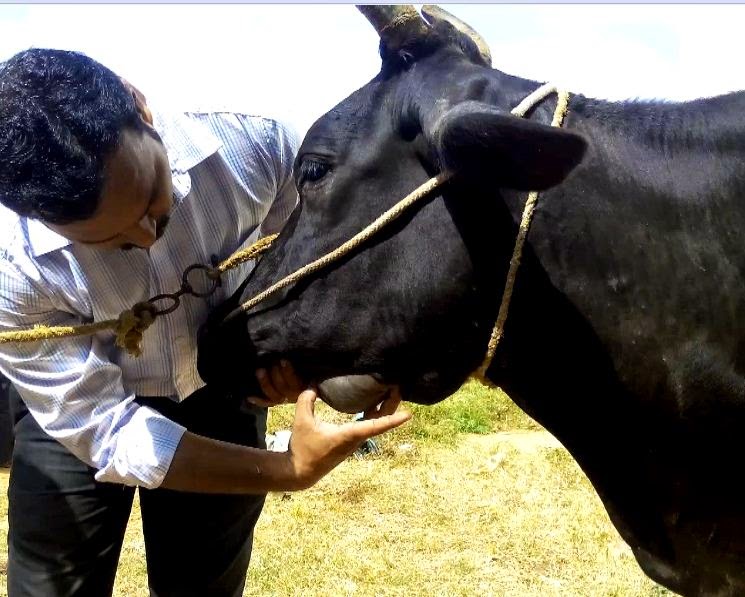
Wednesday, 28 January 2015

BOVINE LAMENESS - PART 1 INTER-DIGITAL FIBROMA CONCURRENT TO CORK SCREW CLAW IN DAIRY CATTLE.

INTER-DIGITAL FIBROMA IN DAIRY CATTLE 

Hoof affections are second largest cause for economic loss in livestock farming . In India, the incidence of foot disorders is 8-10% in Dairy cattle . The over grown hooves is the most common predisposing condition of the hooves that accounts for more than half of the total foot lesions. I get a lot of hoof affections and my recent interest was on preventive management of hoof affections in dairy cattle. Through this starting segment of Bovine lameness series my attempt will be to give some insights on common hoof ailments and their surgical management. Bovine lameness is a SILENT KILLER and huge production loss entity in any organised dairy farming. Pain induced reduction in milk yield is a much focused area for dairy scientist ans Dairy vets .

Interdigital fibroma also termed as Interdigital hyperplasia or corns are firm fibrous masses consisting of hyperkeratotic and parakeratotic skin found in the interdigital space of cattle
 The lesions appear as secondary to chronic skin irritation due to environmental, conformational and hereditary factors. Where lesions become large and/or infected, surgical removal is the preferred treatment. Improved hygiene and appropriate hoof trimming are the keys to prevention of this condition

"Cork screw claw" is the over grown claw with inward curvature making the inter digital space widened. This is a genetic disorder and this predisposes to many inter-digital affections in cow. Dairy cows tend to have a higher prevalance of interdigital fibromas in the rear feet, probably owing to the rear feet contacting more moisture from manure and urine than the front feet. Cork screw claw is generally seen in front limb and due to this reason secondary inter-digital fibroma is common sequelae to cork screw claw in bovines
Surgical management of interdigital fibroma :-

For surgery, animals are best positioned in  chemical restraint. Xylazine Butorphanol and Ketamine combinations proves to be excellent in my experience. A tourniquet should be placed above the fetlock to provide hemostasis.Intravenous regional perfusion or local interdigital injection of a local anesthetic agent should provide adequate surgical anesthesia of the area.Sharp dissection should be accomplished, being certain to remove all proliferated tissue,including tissue immediately adjacent to the coronary band.Care should be taken to avoid damage to the coronary band.

Levlling of the curved claws can be done using an electric hoof trimmer and the inter digital wiring can be done after making fine hole of 3 mm diameter using electric drill.An orthopedic stainless steel wire can be used The toes can be wired together to decrease movement of the claws, but this may not be necessary in housed animals.The entire foot, including the solar surface should be incorporated in a tape bandage with or without gauze. Systemic antibiotics may be indicated if the fibroma is infected.


In some cases even cauterization of the growth can be done followed by antiseptic dressing with povidone iodine or bismuth iodoform paraffin paste. The antiseptic dressing should be continued for a minimum period of 3 to 4 weeks. The animal should be kept on dry floor.Following surgery, the animal should be kept in a dry area for approximately 2 weeks. 


Preventive management:-


  • Timely hoof trimming that prevents the widened inter-digital space resulting from over grown hoof and exercise is the best preventive management practices for this condition.
  • Ensure that cattle stall is made of firm dry floorings. Proper drainage is a must to avoid water logging resulting in the hoof affections in the cattle.
  • Weekly checking the hoof of the animal and cleaning the hoof with 1% potassium permanganate solution can check the spreading of hoof infections.
  • Interdigital hyperplasia caused by poor conformation is very likely to recur, since the predisposing conformation problems will usually remain after removal of the growth.
  • Animals suspected of having interdigital hyperplasia due to hereditary factors should not be used for breeding.
A 7 yr old Dairy cow in a Hi-tech dairy farm in Karnataka was operated for cork screw claw resulting in to interdigital fibroma . You can watch the video below 


THANKS FOR WATCHING


Sunday, 18 January 2015

INTUSSUSCEPTION AND RECTAL PROLAPSE IN PUPPIES: A SEQUELAE TO IMPROPER DEWORMING

Dogs are hosts for wide varieties of worms which includes round worms , tape worms, whip worms  and hook worms. This mainly happen due to the natural behavior of licking, sniffing and snatching any thing on their path like stones, trash, poops and all inanimate objects.

Many times deworming  in pet practice may fail due to improper selection of dewormers , improper dosage and improper procedure of drug administration.
Signs of worms in dogs include Pica or eating inanimate objects , scrotching or rubbing the anus in ground and increased peristaltic movements of intestine , diarrhea and rough hair coat.


It is a common practice among vets to correct the rectal prolapse manually just by pushing the prolapse mass.  But it is pertinent to mention that CHRONIC RECURRENT RECTAL PROLAPSE MAY BE A SEQUELAE TO AN INTESTINAL OBSTRUCTION AND IN WORM INFESTATIONS THIS MAY BE DUE TO AN INTUSSUSCEPTION.

Chronic worm infestations can lead to hypermotility resuting in Torsion, volvulus or intususseption of intestines. Torsion is the rotation of intestines in their own axis. Volvulus is rotation of intestines in mesenteric axis. Where as intussusception is the telescoping of one portion of intestine to other .
Rectal prolapse is the protrusion of the rectum. The codition may arise from hyper motility of intestines. Chronic rectal prolapse is condition in which the rectum get prolapsed and every time an attempt to push it back in position leads to recurrence. The main cause of chronic rectal prolapse may be intestinal obstruction resulting from intussusception.

                  This 4 month old puppy was presented with chronic rectal prolapse nit responsive to medical
treatment. 
According to the owner he had never dewormed the pup and that the pup was eating mud and stones .It had severe diarrhea and scrotching. C ARM imaging revealed hard firm mass on caudal colon .An exploratory laparotomy revealed complicated intussusception at ileo-caeco-colic junction. The condition was difficult to be corrected and hence enterectomy followed by entero anastomoses was performed.  


YOU CAN WATCH THE VIDEO OF CHRONIC RECTAL PROLAPSE COMPLICATED WITH INTUSSUSCEPTION IN A PUPPY.


To prevent an incidence of rectal prolapse, proper deworming is an inevitable measure . There are many types of dewormers such as  pyrantel palmoate, fenbendazole, albendazole, praziquantel , ivermectin etc.

Common dewormers for dogs and efficacy are as under

Dewormer
Hook/ Round worm
Whip worm
Tape worm
Dose mg/kg bw
Pyrantel pamoate
+++
--
--
5-10
Fenbendazole
+++
++
--
50 for 3 days
Praziquantel
++
+++
++
8
Milbemycin
+++
+++
++
0.5
Praziquantel with febantel
+++
++
--

Praziquantel with pyrantel pamoate
+++
+++
+++

Ivemectin
++
++
--
0.02

Right age of deworming in puppy is at 15 days with pyrantel pamoate liquid every 12 days for four times. followed by this a dose of pyrantel pamoate and fenbendazole at months 2,4 and 6. After this every six months deworming can be done using combinations of praziquantel / pyrantel pamoate/ febantel and ivermectin . It is also very important to  alter the combination/ drug every time as the worms also get resistance to wards a single dewormer. In pregnant bitches fenbendazole is the only safe dewormer and this can be used at 10-15  day of gestation to avoid trans placental infection to pups.
  
You are free to post your comments and suggestions . 

Friday, 9 January 2015

HANDLING AND RESTRAINT OF CATS AND CLINICAL VETERINARY SURGERY VIDEO ON FELINE HIND LIMB AMPUTATION

I am thankful to all readers of my blog for  much encouraging response . I am getting mails especially from Veterinary  students, post graduate students of Veterinary Surgery  and field vets of the country and few across the globe. There was a request to post something on feline restraint and feline surgery and this is my humble attempt to share some thing on feline surgery with special reference to handling and restraint of cats .
I am dedicating this segment to all Cat lovers and budding feline vets.
In veterinary practice Cats always fascinated me by their unique nature of Fexibility, Agility  and Unpredictability . Cats are very sensitive and highly freedom loving animals which makes them hyper excited when attempted to restraint.. Handling cats always take much of our energy because of their extreme flexibility . Many times I get cases in which helpless situation arises like owner himself/ herself bring an excited animal and confirming the fact that no one can handle their pets. DILATED PUPILS, PROTRACTED CLAWS AND VOCALIZATION are the indications of a stressed self defensive cat.
Like any other animal, behavioral restraint is the best form of restraint. But in case of an injured animal presented with much stress, careful physical restraint becomes inevitable.
I had learned from my practice that much patience , firmness and tactics are needed for effective handling . Also NEVER EVER UNDERESTIMATE  FELINE FLEXIBILITY.

1.       Principles of blind folding. Vision is the first alarming stimulation for a hyper excited cats . It has been scientifically proved that blind folding in the presence of owner can reduce the stress level in cats .
2.       Cuff holding . The best way to restraint a cat is tight and firm holding of the cuff. This should never be shared by two people as the cats escape and attack effectively  by multiple handling .


       FIRM  CUFF HOLDING AND PRESSING THE BACK BY GENTLE SPINAL RESTRAINT : This is gentle pressing of the vertebral column all along with your fore arm with well restrained cuff of cat in our fist.
This will ensure a firm grip and the animal can be restrained for injections. With this procedure a Surgeon can himself or herself give the injections with out assistance.
Like in all species iintramuscular injections should be always perpendicular with needle insterted to the mid belly of muscles. I prefer inseting only 1/3rd of the hypodermic needle for a painless injection.
Post handling stress. Majority of the injury to the handlers happen after the handling as the animal will be much tensed and tries for self defense. 


Always safely place back in cage after the injection and let loose the animal for natural recovery. Remember cats needs much freedom . Don’t over handle a cat as it reduces its immunity.A good dose of neglect had found to be excellent in recovery of the feline patients . Domestic Cats are also prone for capture myopathy like their wild counter part and hypothermia is a common findings after surgical manipulations.
YOU CAN WATCH A VIDEO ON HANDLING AND RESTRAINT OF CATS 


CHEMICAL RESTRAINT
An injured cat with complete compound metacarpal fracture was presented . A proximal meta tarsal amputation was done on the cat on contrary to a mid  femoral amputation as the situation demanded a less invasive surgery.


Various anesthetic combinations are availiable for restraints if cats. I personally recommend the combination of a dissociative anesthetic , a muscle relaxant and a morphine pain killer for a much rewarding anesthetic retraint. Ketamine @ 10 mg/kg bw + Diazepam @ 0.5 mg/kg bw and Butorphanol @ 0.2 mg/kg bw give surgical plane of anesthesia for nearly 45-55 minutes. This can be further enhanced by a top up of 1/3rd dose after 40 minutes .
YOU CAN WATCH THIS VIDEO ON META-TARSAL AMPUTATION IN A CAT
Ketamine , Diazepam Butorphanol cocktail is excellent for short  medium surgical procedures in cats 

You can forward your feedback, suggestions and recommendation for improvement.

Sunday, 28 December 2014

ATRESIA ANII IN CALF AND SURGICAL MANAGEMENT

Atresia ani (Imperforate anus) is a condition in which  an animal either has a very small opening or no anal opening at the time of birth due to a failure of the anal membrane to break down. 

Typical signs of intestinal atresia include decreased appetite, progressive bilateral abdominal distention, the absence of feces, episodes of straining to defecate, and occasionally, blood-tinges mucous can be found around the rectum

Treatment
Only treatment for  atresia ani  is the Surgical correction. This consists of  surgically opening the blind-ended sac ending at the rectum and suturing around the newly created orifice. Lower epidural anesthesia at C1- C2 (Inter-coccygeal ) junction with 1-1.5 ml lignocaine epidural can desensitize the perineum . Further infiltration at the surgical site of incision can ensure painless  surgical procedure.
Ventral recumbancy with raised hind quarters with tails stretched backwards helps in easy access to the surgical site. Anal reconstruction is done by using close interrupted sutures apposing skin and rectal mucosa.

In field level surgical corrections needs to be attempted at early stage for better success rates. In villages the farmers resort to many cruel corrections methods such as excising with knife , poking with nails and tearing the anus with sharp objects to create opening . The is extremely unscientific and can results in irreparable trauma to the animal. Recently I got this case of nearly one month old calf with atresia anii and the farmer poked the anus with a sharp stick . even though it relieved some meconium it has lead to severe proctitis and adhesion.
 The animal was having toxemia on presentation due to not passing dung for over 2 weeks. An emergency surgery followed by deliberate post-operative care saved the calf.

YOU CAN WATCH THE VIDEO 

Wednesday, 24 December 2014

CLINICAL VETERINARY SURGERY VIDEO SERIES- SURGICAL MANAGEMENT OF DEEP SEATED CHRONIC SUB MANDIBULAR ABSCESS IN A COW

Sub mandibular abscess is not uncommon in cows .Generally abscess get matured in due course of time .Hot fomentation, topical iodine preparation and poultice can hasten the abscess. Which discharges the contents as liquid pus. Pus matures through serous, sero-sanguine , mucous and liquefactive stages. Thick inspissated pus is a characteristic of chronic abscess . Sub-mandibular abscess can either open outside or inside oral cavity. Sub mandibular abscess can also lead to ranula and sub mandibular salivary gland infections. Chronic abscess can get fibrosed leading to hard circumscribed mass pressing the adnexa leading to pressure necrosis of vital structures. 


Surgical excision is indicated for chronic hard fibrosis induced  abscess which when left un attended can lead to functional impairment to the part involved.  


Standing surgeries can be challenging in field but the use of Xylazine Butorphanol Ketamine (XBK) combination at 0.05,0.25 and 0.1 mg/ kg bw gives excellent standing analgesia .Dose of xylazne can be further reduced to half and proportional variation with ketamine and butorphanol in pregnant cows .

PLEASE WATCH THE VIDEO OF A CASE OF CHRONIC DEEP SEATED SUB MANDIBULAR ABSCESS IN A COW.

Tuesday, 23 December 2014

PRINCIPLES OF BEHAVIORAL RESTRAINT AND PAINLESS INTRAMUSCULAR INJECTION IN CATTLE


In Veterinary Practice giving injection is our routine and many  times we find it difficult in giving a less pain shot to the patients who were already compromised with pain .Of all the three methods of restraints, Behavioral restraint is the most evolved , the most rewarding, the most challenging compared to physical and  chemical restraint. Equal co-operation is needed from both handler and the clinician to make an effective painless injection. 
When an animal is presented to a vet , it is already in a tensed state and in case of injuries the mental state of the animal will be totally critical. Above this a rough handling  can lead to severe response from the patients like biting, violent head tilt, kicking  and in some cases  serious injuries to the Vet/ animal handler or collapse of the animal because of violent physical restraint methods. Small manipulations can be effectively done using an effective behavioral restraints. I am sure you all will find this blog useful. Feel free to interacts with comments and suggestion as I believe I too am in an evolving stage.
Many literature are available on physical and chemical restraint of cattle , but hardly we get needed info on behavioral restraint. In this section I will try to cover some facts and findings that I gathered in my practice and effectively got excellent results  in many cases .

Principle of Olfaction :

Cattle can distinguish smell, they can detect pheromones, volatile chemicals that are important in reproduction and feed selection .Olfactory senses in cows are much more developed than in man. So they sense threat and danger by smelling the pheromones of the handler / other animals. Offering your hand in front of the cow gives the animal his/ her own freedom to sniff and this is a mutual introduction which is really rewarding.  By allowing the natural response  you are giving freedom to exhibit natural behavior  , which is in line with the principles of animal welfare.

Principle of Head restraint
By head restraint, we are trying to make the animal control by willful restraint from its side.  Gentle touching the fore head and then holding of the chin with gentle support of horn can be tried in docile animals. Please make it sure that the nose rope pulling doesn’t work in real sense . It evinces breath taking pain and kills the endorphin (The well being hormones which has even adverse effect on milk production in cows  as well ) Looking at the eyes and mutual glancing . I believe that the animals can sense your status  better. (Many wild life attacks are documented to happened because of faulty eye contacts ) Covering the eye lid gently and touching the fore head initiates submissive response in cattle

Principles of Vision. 
Eyes are the mirrors of our soul. So is with the animals too. The angle of vision is different in different species which makes our job so difficult and unique compared to the human doctor. With their eyes positioned on the side of the head, cattle have panoramic vision of 330° and binocular vision of 25°–50°, which allows for good predator awareness . Despite the wide set of their eyes, however, they do have a blind spot directly behind them 
The ears of cattle are very sensitive. Cattle can be calmed by playing soothing music, or stressed by loud noises such as yelling . Dairy breeds are more sensitive to sound and touch than beef breeds, high-pitched sounds, such as the whistle used to control most farm dogs, will increase the animals’ heart rates . Hearing in cattle is important in inter- and intra-species communication .
Cattle flight zones can vary greatly. Feedlot cattle may move away from people, especially strangers,entering their flight zone of 1.5m, whereas less handled range cattle have a flight zone of 30m  Cutaneous sensitivity can be used to calm cattle by scratching under the neck and behind the ears, areas they find difficult to access
Speak to the animal till before you touch and looking at the eyes you can see if the animal is tensed or in an attack mode . Aquaintance with the animal needs keen observation especially understanding his / her own field of vision and perceptions. Once this is clear we can  run our hand across the body and neck .
These steps are pre requesites before yo examine an animal. Once diagnosed and treatment fixed you have to treat with suitable injections

INTRA MUSCULAR INJECTIONS 
IM injections denotes INTRA MUSCULAR (within muscle mass)  and not INTERMUSCULAR(Between the bellies).If you give intermuscular shot it will act as a depot and not easily absorbed in the system and depending on the content of injection it can lead to abscess formation.
 Always  ensure that the needle is perpendicular to muscle mass. This helps in less injury and less neuralgia.There are different sites for giving I/M. but the best painless site is at the gluteus medius muscle ensuring no inury to the iliac vessels. Always ensure that the hub is tightly fixed on the syringe this prevents content spillage and embarrassment in front of the owner.
Depending on the content you can either give thorough post injection massage or not.
And always try to be as gentle and Firm rather than  rough and tough as even we would not tolerate a hard needle prick however beautiful the nurse who pricks.


YOU CAN WATCH THE VIDEO ON PRINCIPLES OF BEHAVIORAL RESTRAINT AND PAINLESS INTRAMUSCULAR INJECTION IN CATTLE.

THANKS FOR VISITING MY BLOG. YOU CAN COMMENT OR PUT YOUR QUERIES TO MY MAIL. I AM MORE THAN HAPPY TO HELP YOU TO HELP AN ANIMAL.
.

Friday, 19 December 2014

CLINICAL VETERINARY SURGERY VIDEO SERIES- CESAREAN SECTION IN A PUG


Cesarean section (Hysterotomy) is a life saving operation for the mother and the foetus. The time of presentation of case is crucial in determining the success of the procedure. Hysterotomy is done on an emergency basis for cases of dystocia refractory to medical management.  Normal gestation period of dogs ae 62-65 days. In this case a 5 yr old Pug was presented with history of straining for past 18 hrs 
On laparotomy,the gravid uterus was exteriorised and  2 dead foetus of normal growth were removed from each horn. 
One foetus was seen blocking the body  resulting in the complete compression of the lumen and the birth canal .This could have been the cause of death for the rest of the pups.In this case the animal had crossed 69  days of gestation and 18 hours of intermittent straining complicated by a faulty blocking foetus at the body of the uterus  had resulted in death of foetuses.  This  emergency casarean section saved her life.


YOU CAN WATCH THE VIDEO